


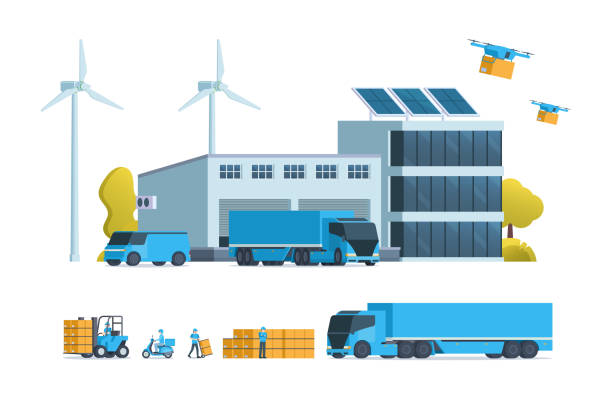
In any industrial setting, from manufacturing plants to sprawling warehouses, the efficient movement of materials is the backbone of productivity. A breakdown or inefficiency in your transport system can lead to significant delays, increased operational costs, and potential safety hazards. Selecting the right equipment isn’t just about moving items from point A to point B; it’s about creating a seamless, reliable, and safe workflow that supports your entire operation. This guide explores several dependable transport solutions that are proven to enhance efficiency and productivity in demanding industrial environments.
1. Automated Guided Vehicles (AGVs)
Automated Guided Vehicles are robotic, self-driving carts that transport materials without direct human operation. They navigate along predefined paths using wires, magnetic strips, or advanced laser-based guidance systems. AGVs are highly reliable for repetitive tasks, such as moving finished products from the assembly line to storage or delivering raw materials to production stations. By automating these routine movements, facilities can significantly reduce the risk of human error and workplace accidents.
Furthermore, modern AGVs are equipped with sophisticated sensors and safety mechanisms that allow them to detect and avoid obstacles, ensuring a safe operational environment alongside human workers. Their scalability also means businesses can add more units as their operational needs grow, making them a flexible long-term investment.
2. Heavy-Duty Forklifts
Forklifts are a cornerstone of material handling in countless industrial environments, and for good reason. These powerful vehicles are indispensable for lifting and transporting heavy pallets, containers, and bulk materials over short to medium distances. Modern heavy-duty forklifts come in various configurations, including electric, propane, and diesel models, each suited for different operational demands and environments.
Electric forklifts, for example, are ideal for indoor use due to their zero emissions, while diesel models offer greater power and torque for challenging outdoor applications. Operator training is crucial for ensuring safe and efficient use, but once implemented, a well-maintained fleet of forklifts provides unmatched versatility and strength for tasks that require both mobility and heavy-lifting capability.
3. Industrial Conveyor Systems
When it comes to moving a high volume of goods consistently over a fixed path, an industrial conveyor system is often the most efficient solution. These systems range from simple roller conveyors, which use gravity or manual power, to complex, motorized belt or chain conveyors that can handle everything from small components to large, bulky items. Conveyors are exceptionally reliable because they offer continuous, automated movement, minimizing manual handling and reducing the potential for product damage. They are integral to assembly lines, packaging stations, and distribution centers where a steady flow of materials is critical. Integrating a conveyor system can dramatically increase throughput, reduce labor costs, and improve the overall ergonomic safety for employees by eliminating the need for repetitive lifting and carrying.
4. Overhead Crane Systems
For lifting and moving extremely heavy or oversized loads within a specific area, overhead cranes are the gold standard. These systems, which include bridge cranes, gantry cranes, and jib cranes, operate above the factory floor, freeing up valuable ground space for other activities. Overhead cranes are capable of lifting loads far beyond the capacity of forklifts, often handling materials weighing many tons.
They provide precise, three-axis movement (vertical, longitudinal, and lateral), allowing for the exact placement of heavy machinery, raw materials, or large components. Because they operate in a controlled, designated area, they are one of the safest methods for handling massive loads, provided they are operated by certified personnel and undergo regular maintenance checks.
5. Electric Tugs and Tow Tractors
Electric tugs and tow tractors are a highly effective solution for transporting multiple carts or trolleys in a single train. These compact, powerful vehicles can pull significant loads, making them ideal for moving parts from a central storage area to various points along an assembly line or for order picking in a large warehouse.
Because they are battery-powered, they are quiet, emission-free, and suitable for indoor use. Using a tow tractor to move a train of carts is far more efficient than making multiple trips with a single-cart-pushing system or a forklift, saving both time and labor. They also enhance worker safety by reducing the physical strain associated with manually pushing heavy carts.
6. Vertical Lifts and Mezzanine Conveyors
In multi-level facilities, moving materials between floors can present a significant bottleneck. Vertical lifts, also known as Vertical Reciprocating Conveyors (VRCs), are specifically designed to transport goods safely and efficiently between different elevations. Unlike elevators, VRCs are intended exclusively for materials, not people, which simplifies their design and regulatory requirements. They can handle heavy palletized loads, carts, and large boxes, integrating seamlessly with horizontal conveyor systems on each floor. This creates a fully automated, multi-story transport network that maximizes the use of vertical space and keeps the workflow moving without interruption or the safety risks associated with using forklifts for inter-floor transport.
