

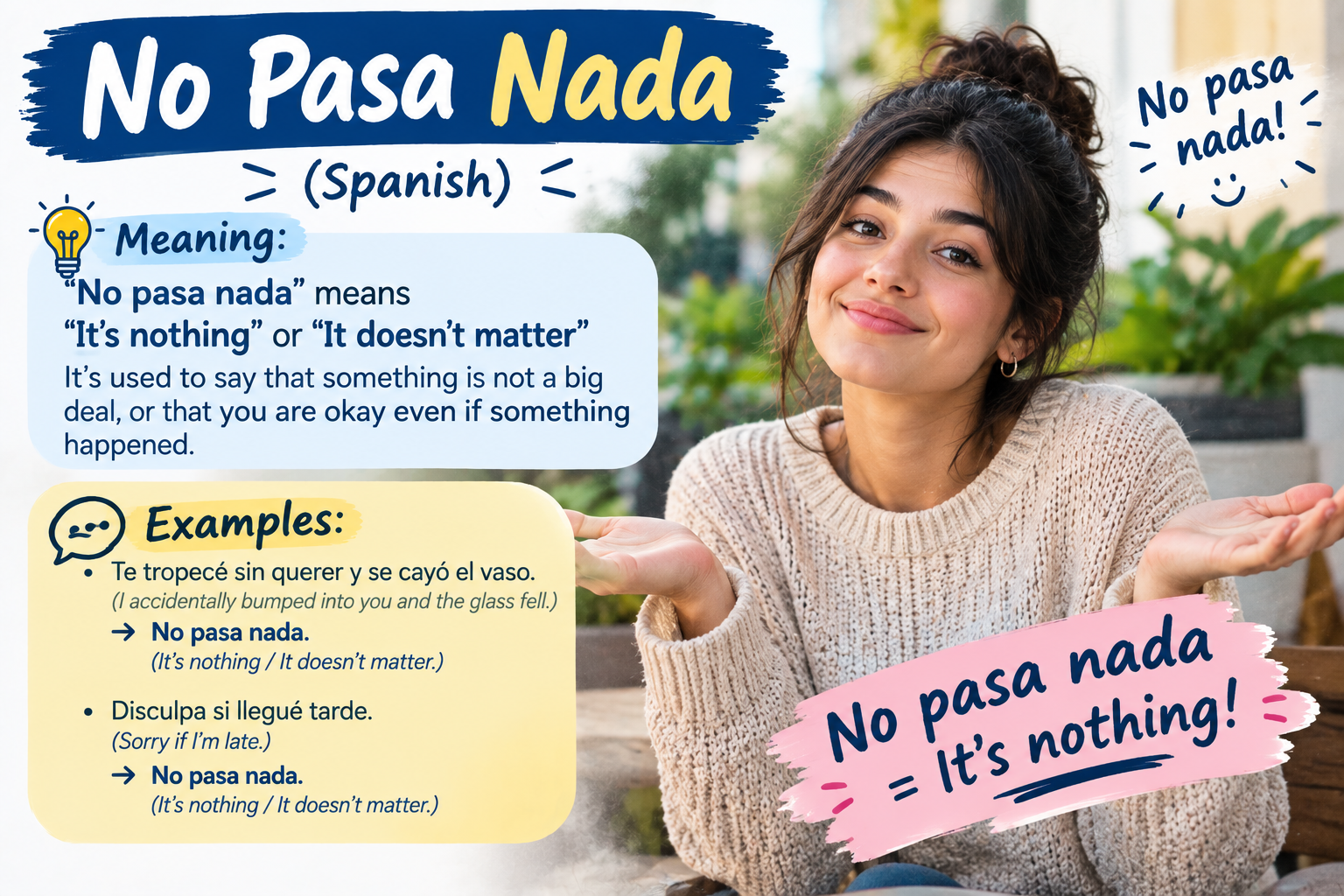
No pasa nada is a popular Spanish phrase that literally translates to “nothing happens,” but functionally means “no worries,” “it’s all good,” or “don’t worry about it.” It is widely used across Spain and Latin America to soothe minor stress, brush off small mistakes, and maintain a relaxed, positive vibe.
When building a brand, selecting a name, or mastering conversational Spanish, understanding cultural context is everything. Relying on literal translations without strategic context often leads to awkward phrasing or flat brand messaging. Learning the exact nuance behind phrases like no pasa nada—alongside exploring cool Spanish phrases and relaxed naming concepts—helps you communicate with effortless authority.
Let’s break it down simply.
What Does No Pasa Nada Mean? (Linguistic & Cultural Context)
At its core, no pasa nada is the ultimate linguistic safety net in Spanish-speaking cultures. It serves as an emotional soft landing in daily interactions.
Here is how the phrase breaks down grammatically and contextually:
- No: Not / No.
- Pasa: From the verb pasar (to pass, to happen, or to occur).
- Nada: Nothing.
While the word-for-word translation is “nothing happens,” native speakers use it as an all-in-one remedy for minor awkwardness, accidental delays, or slight mistakes. It carries an inherent mindset of resilience, ease, and emotional warmth.
Categorized Variations and Related Expressions
Depending on your brand persona, conversation style, or aesthetic goals, different variations of this phrase deliver distinct tones.
1. Casual & Conversational
- No pasa nada | No worries / It’s fine | Best for daily banter, customer support re-framing, and relaxed lifestyle branding.
- No hay de qué | Don’t mention it / You’re welcome | Best for polite responses after someone thanks you.
- No hay problema | No problem | Best for straightforward, clear resolution of minor issues.
2. Ultra-Relaxed & Modern
- Tranquilo / Tranquila | Chill out / Take it easy | Best for calming high-friction situations instantly.
- Todo bien | All good / Everything’s fine | Best for quick status updates or casual greetings among friends.
- Cero estrés | Zero stress | Best for modern wellness, activewear, or productivity brands focused on ease.
3. Philosophical & Mindful
- Así es la vida | That’s life | Best for accepting situations beyond your control with grace.
- Sin pena | Without worry / Without embarrassment | Best for encouraging bold action and confidence.
- Avanza tranquilo | Move forward calmly | Best for coaching, mentorship, or calm tech platforms.
Linguistic & Naming Psychology Breakdown
Why does the no pasa nada meaning resonate so deeply in both conversation and modern brand identity? The secret lies in phonetic structure and emotional psychology.
Soft Phonetic Flow
The repetition of open vowel sounds—specifically the soft “a” tones in pasa and nada—creates a rhythmic, soothing auditory experience. Consonants like “p” and “d” are soft plosives and dentals, preventing the phrase from sounding harsh or defensive.
Psychological Relief
Human brains are wired to react to conflict or mistakes with heightened tension. Hearing or reading a phrase that signaling immediate resolution lowers cognitive friction. In branding, adopting this tone signals high emotional intelligence, approachable authority, and stress-free service.
Meaning and Usage Matrix
| Phrase / Expression | Literal Meaning | Emotional Vibe | Ideal Use Case or Brand Fit |
| No pasa nada | Nothing happens | Reassuring, effortless, friendly | Lifestyle products, customer service ethos, casual conversations |
| Todo bien | Everything good | Cool, balanced, low-maintenance | Modern streetwear, coffee shops, social apps |
| Tranquilo | Calm / Quiet | Grounded, serene, peaceful | Wellness retreats, skincare lines, meditation platforms |
| Sin problemas | Without problems | Efficient, reliable, confident | Logistics, SaaS platforms, professional services |
Common Pitfalls When Using Culturally Rich Phrases
Here’s where most founders and learners get it wrong:
- Overusing it in serious contexts: Saying “no pasa nada” when a major error occurs can sound dismissive or dismissive rather than comforting. Reserve it for low-stakes situations.
- Ignoring regional nuances: While universally understood, some regions prefer local slang (like no hay bronca in Mexico or no pasa na’ in casual southern Spanish).
- Literal translation traps: Trying to translate “no worries” back into Spanish word-for-word can lead to unnatural phrasing. Stick to authentic idioms.
- Misaligning tone with brand values: If your brand positioning is hyper-formal, precise, or high-urgency, ultra-relaxed phrasing creates brand dissonance.
Strategic Framework to Validate Strategic Expressions
If you are evaluating expressions or brand names built around relaxed Spanish phrases, run them through this four-step validation model:
- Test Auditory Friction: Say the phrase aloud five times fast. Is it effortless to pronounce for your target market?
- Verify Semantic Fit: Does the phrase match the exact emotional response you want your audience to feel during a friction point?
- Check Cultural Authenticity: Run the expression by native speakers across your target geographic regions to ensure positive associations.
- Confirm Trademark & Domain Clarity: If adopting the term for a business, check registry databases and domain extensions early to avoid costly legal bottlenecks.
Frequently Asked Questions
Is “no pasa nada” polite or informal?
It is friendly and informal, making it perfect for daily interactions, friends, colleagues, and casual business environments. In extremely formal or corporate settings, a phrase like no se preocupe (don’t worry) is preferred.
What is the difference between “no pasa nada” and “de nada”?
De nada specifically means “you’re welcome” in response to a thank you. No pasa nada means “no worries” or “it’s okay,” typically used in response to an apology or a small mishap.
Can “no pasa nada” be used as a brand name or slogan?
Yes. Its built-in emotional resonance makes it an ideal slogan or identity anchor for lifestyle, apparel, wellness, or hospitality brands that want to project ease, calm, and approachable warmth.
The Golden Rule of Cultural Naming and Phrasing
Context dictates meaning. A phrase is only as powerful as the intent, tone, and empathy behind it—choose words that reduce friction and build instant connection.
