

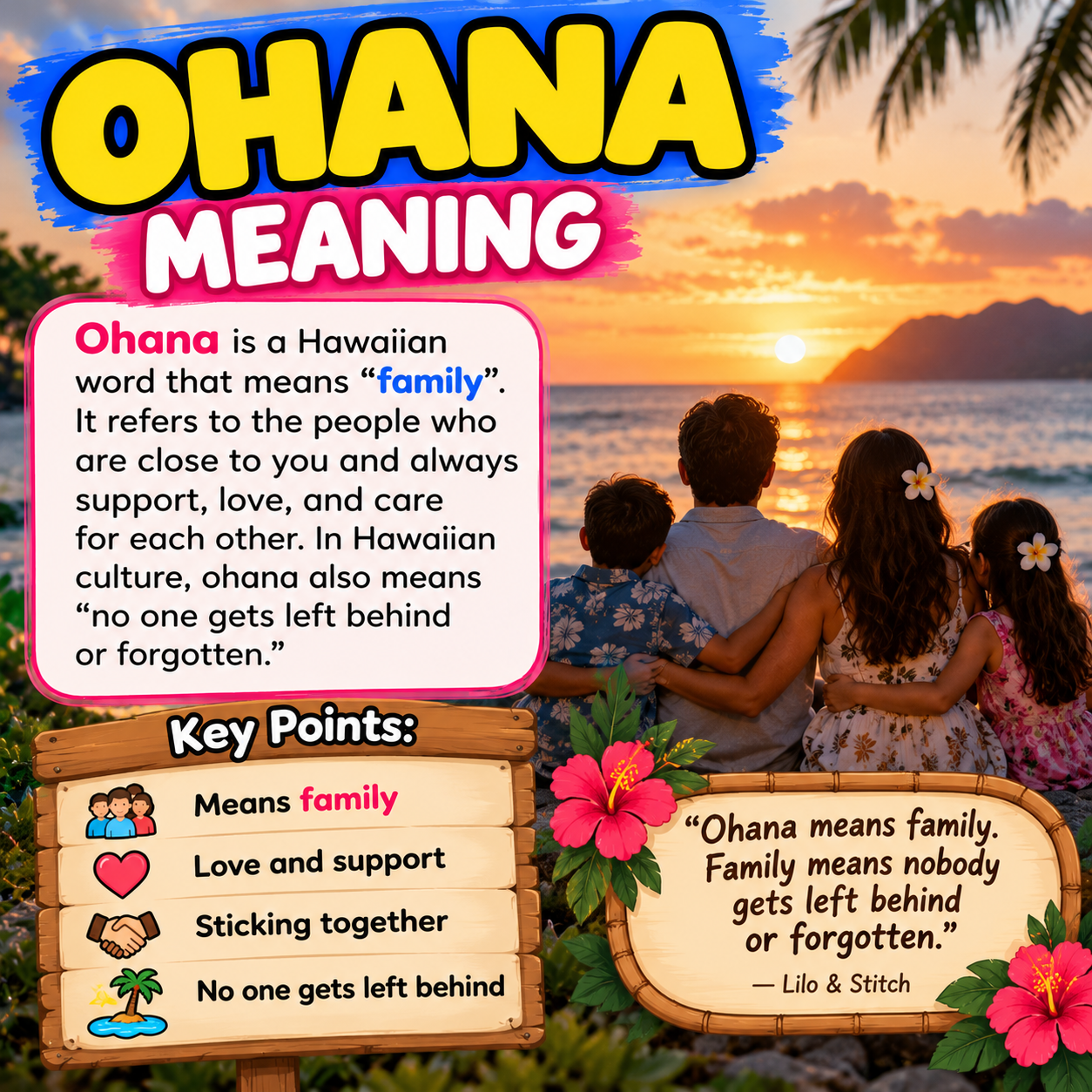
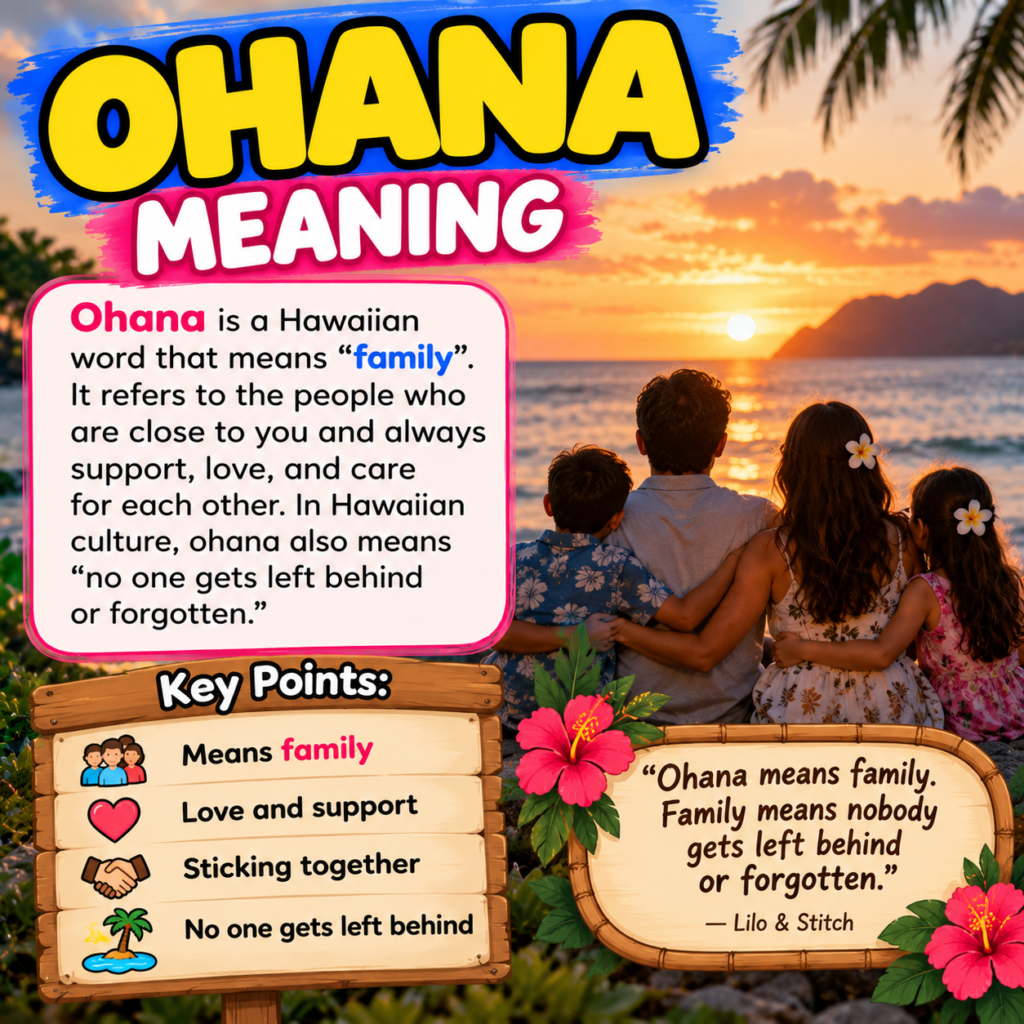
What is the true ohana meaning? At its core, ohana is the Hawaiian word for family, but its actual cultural meaning extends far beyond blood relations to include extended family, close friends, adopted members, and interconnected communities bound by mutual responsibility. In modern brand strategy, understanding the ohana concept in business allows founders to build deep, trust-based communities that convert casual buyers into lifelong brand advocates.
Many name generators throw random Hawaiian words at you without giving you the cultural or psychological context behind them. Doing that risks misrepresenting a deeply rooted cultural tradition, or picking a name that completely misses your brand’s actual positioning.
What Is the True Ohana Meaning? (Linguistic & Cultural Roots)
The word ohana comes from oha, the root stalk of the taro plant (kalo), which has been the fundamental staple food of Hawaiian culture for centuries.
<div class="ohana-part">
  <div class="ohana-word">Oha</div>
  <div class="ohana-desc">Root stalk of taro</div>
</div>

<div class="ohana-symbol">+</div>

<div class="ohana-part">
  <div class="ohana-word">Na</div>
  <div class="ohana-desc">Plural / Abundance</div>
</div>

<div class="ohana-symbol">=</div>

<div class="ohana-result">
  <div class="ohana-word">Ohana</div>
  <div class="ohana-desc">All sprouts off the same root</div>
</div>Just as multiple taro shoots grow directly from the same ancestral root, every member of an ohana branches out from a shared foundation.
Here is how the concept breaks down across three distinct dimensions:
- Literal Meaning: Offshoots or sprouts originating from the same taro root.
- Cultural Context: An inclusive, bound community where no one is left behind, forgotten, or intentionally excluded.
- Brand Strategy Context: An emotional framework where customers are treated as vital members of an inner circle rather than transactional data points.
Categorized Name Ideas Inspired by Ohana & Community
If you are looking to build a brand identity anchored in unity, community, and belonging, explore these curated naming concepts:
1. Warm & Community-Driven Names
- Ohanakai | Vibe: Ocean family, calm unity | Best For: Sustainable lifestyle brands, coastal apparel.
- Kith & Root | Vibe: Grounded togetherness, tradition | Best For: Organic foods, wellness retreats.
- TribeCraft | Vibe: Modern collective, shared creation | Best For: Co-working spaces, creator platforms.
- Aina Collective | Vibe: Connected to the land, eco-friendly | Best For: Sustainable skincare, eco-resorts.
2. Modern & Minimalist Names
- Kinfolk Studio | Vibe: Clean, intentional, warm | Best For: Interior design, editorial media.
- Oha Group | Vibe: Sleek, foundational, rooted | Best For: Venture capital, holding companies.
- Coterie | Vibe: Exclusive yet welcoming | Best For: Private membership clubs, boutique SaaS.
- Siloa | Vibe: Soft phonetic flow, quiet strength | Best For: Healthtech, mindful apps.
3. High-Impact & Catchy Names
- Ohana Drive | Vibe: Action-oriented, collective momentum | Best For: Non-profits, community apps.
- Bonded Co. | Vibe: Direct, reliable, structural | Best For: Financial services, insurance platforms.
- Kindred Nation | Vibe: Expansive, movement-level reach | Best For: E-commerce brand communities, podcasts.
- Laulima Works | Vibe: Hawaiian for “many hands working together” | Best For: Collaborative software, agency collectives.
Naming Psychology: Why Community-Centric Names Work
Human beings are hardwired for belonging. When a brand incorporates the ohana concept in business, it triggers powerful psychological responses:
- Phonetic Warmth: Open vowel sounds (like the o and a sounds in ohana) register as approachable, soft, and human, reducing immediate consumer skepticism.
- In-Group Attachment: Aligning your name with family values shifts customer perception from transactional utility to emotional loyalty.
- High Recall & Low Friction: Short, rhythmic names with distinct root words are easier to remember and spread organically through word-of-mouth.
Brand Fit & Meaning Comparison Matrix
| Brand Concept | Core Meaning / Vibe | Ideal Industry / Brand Fit | Domain Strategy Tip |
| Ohana-Inspired | Unconditional inclusion, shared duty | Community platforms, family services | Pair with .co or .com with action prefixes |
| Kinship-Based | Deep connection, shared values | Financial literacy, boutique agencies | Keep phonetics under 3 syllables |
| Taro/Root-Based | Sustainable origin, foundational growth | Organic food, eco-tech, venture funds | Focus on clean, short .com domains |
| Collective-Based | Peer-to-peer collaboration, group strength | B2B SaaS, co-working, creator tools | Add functional suffixes like Lab or Studio |
Common Pitfalls When Choosing Community-Inspired Names
- Cultural Misappropriation: Using sacred or deeply nuanced indigenous terms without understanding their true linguistic context can backfire on your brand.
- Pronunciation Friction: If customers stumble over how to pronounce or spell your name on the first try, you lose organic search traffic and word-of-mouth momentum.
- Scalability Bottlenecks: Pick a name that allows your business to grow. A name that is too specific to a local neighborhood might hold you back if you expand globally.
- Trademark Conflicts: Always check global trademark databases early. Common words associated with family and community often carry heavy trademark overlap in major business classes.
4-Step Framework for Validating Your Brand Name
- Acoustic Testing: Say the name aloud 10 times in standard conversation. Does it feel natural, or does it cause hesitation?
- The “Coffee Shop” Test: Tell someone the name in a noisy room. Can they write it down correctly on a napkin without asking you to spell it out?
- GEO & Search Audit: Search the term across Google, ChatGPT, and Perplexity. Ensure your target keyword isn’t already dominated by an untargeted, massive entity.
- Trademark & Domain Clearance: Verify exact-match domain availability and clear class-specific trademarks before committing to branding assets.
Frequently Asked Questions
What is the literal translation of the Hawaiian word Ohana?
The word ohana comes from oha, the root stalk of the taro plant. Culturally, it translates to family, but connotes an interconnected group whose members are bound by mutual support and responsibility.
How can businesses authentically use the ohana concept in business?
Businesses use the ohana concept in business by prioritizing customer trust, transparent service, employee care, and building an inclusive community rather than focusing solely on one-off sales.
Is the word Ohana trademarked?
While the standalone word ohana is a natural language term, it is registered as a trademark in specific trademark classes by various corporations (such as Salesforce’s Ohana culture initiatives or Disney). Always perform a trademark search for your specific industry class.
