

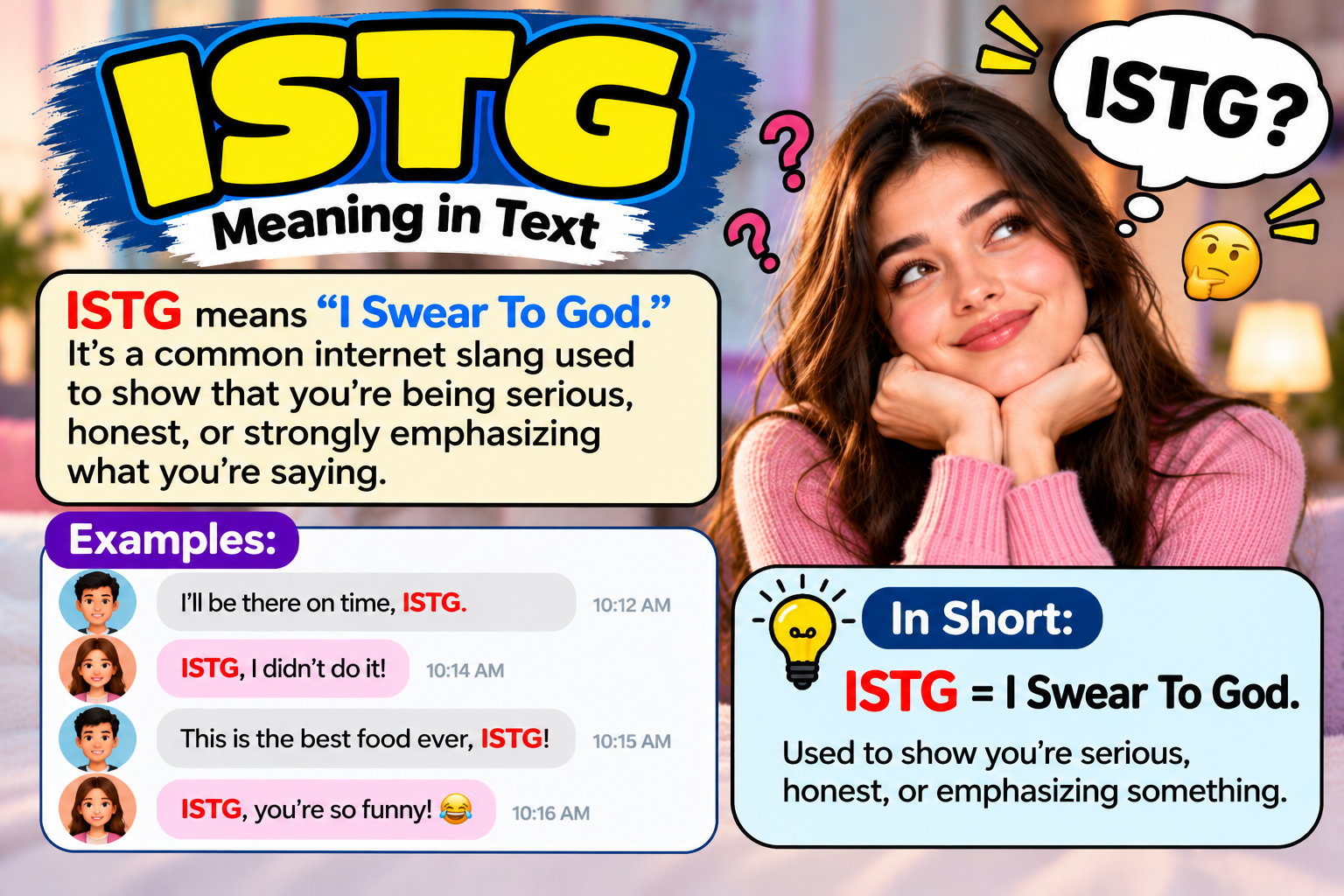
ISTG stands for “I Swear To God.” It is a popular internet acronym used in text messages, social media posts, and online chats to emphasize sincerity, frustration, or strong emotion. Whether someone is promising they are telling the truth or expressing complete annoyance, ISTG communicates immediate honesty and high intensity.
<!DOCTYPE html>
<html lang="en">
<head>
  <meta charset="UTF-8">
  <meta name="viewport" content="width=device-width, initial-scale=1.0">
  <title>Quick ISTG Summary</title>

  <style>
    * {
      box-sizing: border-box;
      margin: 0;
      padding: 0;
    }

    body {
      font-family: Arial, Helvetica, sans-serif;
      background: #f4f7fb;
      color: #172033;
      padding: 40px 20px;
    }

    .summary-box {
      max-width: 1000px;
      margin: 0 auto;
      background: #ffffff;
      border: 2px solid #172033;
      border-radius: 18px;
      overflow: hidden;
      box-shadow: 0 12px 35px rgba(0, 0, 0, 0.08);
    }

    .title {
      background: #172033;
      color: #ffffff;
      text-align: center;
      padding: 24px 15px;
      font-size: 28px;
      font-weight: 800;
      letter-spacing: 0.8px;
    }

    table {
      width: 100%;
      border-collapse: collapse;
    }

    tr {
      border-bottom: 1px solid #dfe5ee;
    }

    tr:last-child {
      border-bottom: none;
    }

    td {
      padding: 24px 28px;
      vertical-align: middle;
      line-height: 1.5;
    }

    .label {
      width: 30%;
      background: #f1f4f8;
      font-size: 17px;
      font-weight: 800;
      border-right: 1px solid #dfe5ee;
    }

    .value {
      width: 70%;
      font-size: 16px;
      font-weight: 600;
      color: #3f4b60;
    }

    /* Row accents */

    .row-1 .label {
      color: #2878f0;
      border-left: 6px solid #2878f0;
    }

    .row-2 .label {
      color: #7650d8;
      border-left: 6px solid #7650d8;
    }

    .row-3 .label {
      color: #e47721;
      border-left: 6px solid #e47721;
    }

    .row-4 .label {
      color: #15966f;
      border-left: 6px solid #15966f;
    }

    .tag {
      display: inline-block;
      padding: 8px 13px;
      margin: 3px 5px 3px 0;
      border-radius: 20px;
      background: #ffffff;
      border: 1px solid #d8deea;
      font-size: 14px;
      font-weight: 700;
    }

    .blue-tag {
      color: #2878f0;
      background: #eef5ff;
      border-color: #bfd5fa;
    }

    .purple-tag {
      color: #7650d8;
      background: #f5f0ff;
      border-color: #d8c9f5;
    }

    .orange-tag {
      color: #d66d19;
      background: #fff4e9;
      border-color: #f0d0ad;
    }

    .green-tag {
      color: #168866;
      background: #ecfaf5;
      border-color: #bfe5d8;
    }

    .footer {
      padding: 18px 20px;
      text-align: center;
      background: #f7f9fc;
      color: #667085;
      font-size: 14px;
      line-height: 1.5;
    }

    @media (max-width: 700px) {

      body {
        padding: 20px 10px;
      }

      .title {
        font-size: 22px;
        padding: 20px 10px;
      }

      table,
      tbody,
      tr,
      td {
        display: block;
        width: 100%;
      }

      tr {
        border-bottom: 1px solid #dfe5ee;
      }

      .label {
        border-right: none;
        border-bottom: 1px solid #dfe5ee;
        padding: 17px 20px;
      }

      .value {
        padding: 17px 20px 22px;
        font-size: 14px;
      }

      .tag {
        font-size: 13px;
        padding: 7px 11px;
      }

      .footer {
        font-size: 13px;
      }
    }
  </style>
</head>

<body>

  <div class="summary-box">

    <div class="title">
      QUICK ISTG SUMMARY
    </div>

    <table>

      <!-- Full Form -->
      <tr class="row-1">
        <td class="label">
          Full Form
        </td>

        <td class="value">
          <span class="tag blue-tag">
            I Swear To God
          </span>
        </td>
      </tr>

      <!-- Primary Context -->
      <tr class="row-2">
        <td class="label">
          Primary Context
        </td>

        <td class="value">
          <span class="tag purple-tag">Texting</span>
          <span class="tag purple-tag">TikTok</span>
          <span class="tag purple-tag">Instagram</span>
          <span class="tag purple-tag">Snapchat</span>
          <span class="tag purple-tag">X (Twitter)</span>
        </td>
      </tr>

      <!-- Tone / Vibe -->
      <tr class="row-3">
        <td class="label">
          Tone / Vibe
        </td>

        <td class="value">
          <span class="tag orange-tag">Sincere</span>
          <span class="tag orange-tag">Frustrated</span>
          <span class="tag orange-tag">Dramatic</span>
          <span class="tag orange-tag">Emphatic</span>
        </td>
      </tr>

      <!-- Primary Meaning -->
      <tr class="row-4">
        <td class="label">
          Primary Meaning
        </td>

        <td class="value">
          <span class="tag green-tag">
            Confirming truth OR expressing exasperation
          </span>
        </td>
      </tr>

    </table>

    <div class="footer">
      ISTG is commonly used online to emphasize sincerity,
      frustration, or strong emotion.
    </div>

  </div>

</body>
</html>
Understanding modern digital communication requires knowing how digital slang operates across platforms. Generic acronym guides often fail to explain how a term feels in conversation, which is where understanding internet slang origin and emotional nuance becomes essential.
What Does ISTG Means in Text and Social Media?
In modern messaging, ISTG serves two primary emotional functions depending on the context of the conversation:
- Expressing Serious Sincerity: Used when someone wants you to believe what they are saying without doubt.
- Expressing Exasperation or Frustration: Used when someone has reached their limit with a situation, person, or event.
Real-World Text Examples
- Sincerity: “ISTG I didn’t forget your birthday, my phone died yesterday!”
- Frustration: “If this app crashes one more time ISTG I’m deleting it.”
- Amazement: “That was ISTG the best movie I have seen all year.”
Categorized Variations and Related Texting Slang
Digital communication relies on specific clusters of acronyms to convey tone. Here is how ISTG fits alongside similar expressions:
1. High-Emphasis Acronyms
- ISTG | I Swear To God | Best for high-stakes truth-telling or intense frustration.
- FR | For Real | Best for casual agreement or validating a statement.
- NGGL | Not Gonna Lie | Best for opening an honest or vulnerable opinion.
- IYKYK | If You Know You Know | Best for inside jokes or niche references.
2. Emotional Amplifiers
- TBH | To Be Honest | Soft honesty; less intense than ISTG.
- RN | Right Now | Adds immediate urgency to an emotional state.
- SMH | Shaking My Head | Disapproval or disappointment without the intensity of ISTG.
Linguistic & Naming Psychology: Why “ISTG” Works
From a linguistic perspective, acronyms like ISTG act as phonetic shortcuts for non-verbal emotional cues. In face-to-face conversation, human beings rely on facial expressions, vocal pitch, and body language to convey intensity. In digital text, those signals are lost.
Acronyms bridge this gap:
- Phonetic Compression: Reducing four heavy, solemn words (I Swear To God) into four rapid-fire letters (ISTG) allows the sender to maintain conversational pace while injecting raw emotion.
- Cognitive Anchoring: When a reader sees capital letters like ISTG, the brain interprets it as a vocal emphasis or an exclamation.
- Subcultural Alignment: Using updated internet slang signals that the sender is culturally fluent in modern digital spaces.
Meaning & Context Comparison Matrix
| Acronym | Full Meaning | Primary Emotional Vibe | Ideal Usage Context |
| ISTG | I Swear To God | Intense / Sincere / Frustrated | High-emotion texts, serious promises, venting |
| FR | For Real | Casual / Supportive | Agreeing with a friend, double-checking facts |
| NGL | Not Gonna Lie | Soft Honesty / Unfiltered | Sharing a controversial or personal opinion |
| TBH | To Be Honest | Neutral / Reflective | Giving feedback, casual conversation |
| SMH | Shaking My Head | Disappointed / Exasperated | Reacting to foolish behavior or bad news |
Common Pitfalls When Using ISTG
Using digital acronyms incorrectly can lead to tone misinterpretations or awkward social dynamics.
- Overusing the Term: Using ISTG in every sentence dilutes its emotional impact. If everything is an emergency promise, nothing is.
- Formal Misplacement: Never use ISTG in professional emails, customer support tickets, or workplace communications on platforms like Slack or Teams unless the team culture is explicitly casual.
- Misinterpreting the Tone: Assuming ISTG always means anger. Context dictates whether the user is upset or simply being honest.
Strategic Selection Framework: Decoding Online Slang in Real Time
When encountering unfamiliar abbreviations or deciding whether to use them, follow this simple three-step filter:
- Assess the Stakes: Is the conversation casual or professional? Reserve acronyms like ISTG strictly for informal, peer-to-peer messaging.
- Read the Room: Look at the emotional tone of the preceding messages. Match the intensity level of the group or recipient.
- Check Capitalization: Lowercase (
istg) usually implies casual emphasis or mild annoyance. Uppercase (ISTG) signals heavy emotion, shouting, or strict urgency.
Frequently Asked Questions
What does ISTG stand for in texting?
ISTG stands for “I Swear To God.” It is an acronym used in text messages and social media to emphasize that a statement is completely truthful or to express frustration.
Is ISTG considered rude or offensive?
It depends on the audience. Because it references a religious phrase, some individuals or formal groups may find it mild profanity or overly dramatic. In casual texting among peers, it is standard internet slang.
What is the difference between ISTG and FR?
ISTG (“I Swear To God”) carries higher emotional intensity and is used for swearing to a fact or expressing annoyance. FR (“For Real”) is more relaxed and is used to confirm agreement or ask if something is genuine.
