

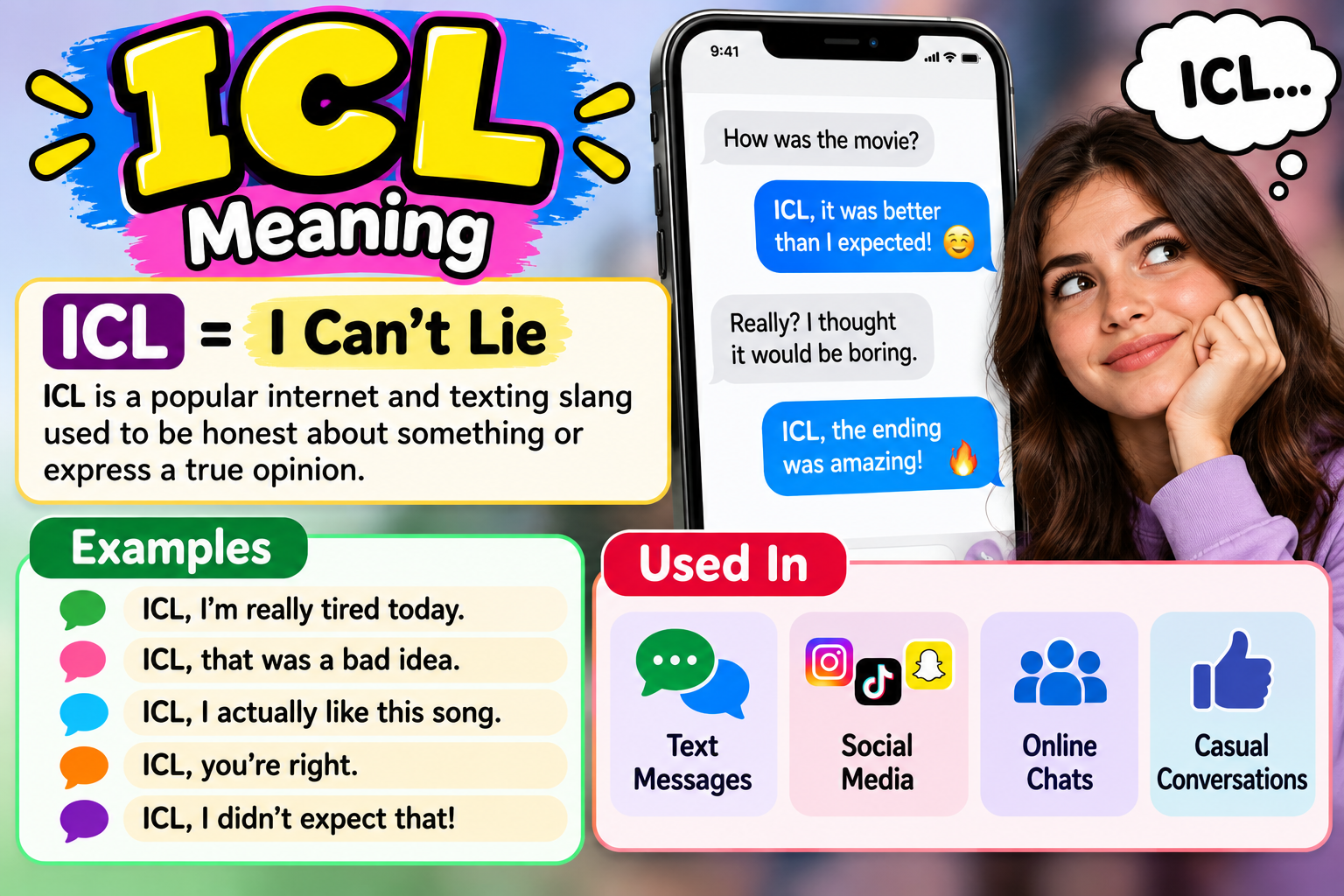
ICL stands for “I Can’t Lie” in text messages, social media posts, and online conversations. It is a popular internet slang acronym used to express raw honesty, introduce a candid opinion, or emphasize a genuine confession before making a statement.
If you have ever stared at a message reading “ICL that design is insane” and wondered what it actually means, you are not alone. Internet slang evolves at light speed, transforming casual conversational abbreviations into major digital communication trends. Beyond everyday messaging on TikTok, Snapchat, and Instagram, understanding slang terms like ICL—and broader internet slang meanings—gives creators, marketers, and brand strategists a clear window into how digital audiences speak when they are being completely authentic.
Here is your complete guide to what ICL means, how to use it, its linguistic psychology, and how to apply modern casual language to your naming strategy.
What Does ICL Mean? (Core Definitions & Context)
In almost every modern digital context, ICL is an abbreviation for “I Can’t Lie.”
It functions identically to phrase starters like “To be honest” (TBH), “Real talk,” or “Not gonna lie” (NGL). Users drop it at the beginning or end of a sentence to signal transparency, build instant rapport, or soften a hot take.
Variations and Related Slang
- ICL = I Can’t Lie
- NGL = Not Gonna Lie
- TBH = To Be Honest
- FR = For Real
- ISTG = I Swear To God
Categorized Examples of How ICL Is Used Online
To help you decode how this slang fits into real conversations, here is a breakdown across different vibes, social platforms, and digital communication styles.
1. Casual & Aesthetic Social Posts
- ICL this lighting is carrying the entire photo. | Vibe: Self-deprecating, casual humor | Best For: Instagram captions, TikTok overlays.
- ICL I’ve replayed this song 20 times today. | Vibe: Unfiltered confession | Best For: Music commentary, aesthetic vlogs.
2. Conversational Text Messaging
- ICL I am way too tired to go out tonight. | Vibe: Direct, vulnerable honesty | Best For: Group chats, peer-to-peer texting.
- That test was impossibly hard, ICL. | Vibe: Conversational closure | Best For: Casual group chat discussions.
3. Professional & Creator-Focused Contexts
- ICL that rebrand hit the mark perfectly. | Vibe: Direct praise without fluff | Best For: Creator feedback, informal Slack channels.
- ICL the first draft was weak, but this layout works. | Vibe: Constructive candor | Best For: Creative collaboration, feedback loops.
Linguistic & Naming Psychology Breakdown
Why do three simple letters like ICL carry so much weight in online communication? The secret lies in conversational signaling and social proof.
ICLConversational Starter
➜
Lowers Audience Defenses
➜
Builds Instant Authenticity
1. Phonic Simplicity & High-Speed Cadence
The acronym ICL relies on hard, crisp consonant sounds (I – C – L). In digital communication, shorter text strings lower reading friction. When spoken or read mentally, it breaks down into three quick syllables that interrupt standard text flow, commanding immediate attention.
2. The Psychology of Radical Candor
Starting a statement with “I Can’t Lie” performs a psychological trick: it establishes vulnerability before delivering an opinion. It tells the reader, “I am stripping away political correctness or social performance right now.”
For brands looking at modern internet slang meanings, this psychological trigger is critical. Audiences in 2026 value authenticity above all else. Brands that understand how casual language signals trust can write better ad copy, build stronger brand identities, and select domain names or campaign hooks that feel human rather than corporate.
Slang & Conversational Meaning Matrix
Here is how ICL compares against other popular conversational acronyms in digital culture:
| Slang Term | Full Phrase | Primary Meaning / Vibe | Ideal Context / Usage |
| ICL | I Can’t Lie | Direct honesty, subtle emphasis, candid opinion | Casual social captions, informal feedback, messaging |
| NGL | Not Gonna Lie | Pre-empting a controversial or surprising take | Hot takes, product reviews, casual commentary |
| TBH | To Be Honest | General transparency or soft critique | Text chats, peer advice, feedback channels |
| FR | For Real | Agreement, validation, seriousness | Confirming statements, agreement in chats |
| IYKYK | If You Know, You Know | Insider exclusivity, niche culture reference | Brand hooks, community-building content |
Common Pitfalls When Using Slang in Copy & Naming
Using trendy terms like ICL can boost engagement, but forcing it can quickly ruin your credibility. Here is where creators and brands usually mess up:
- Overusing it in formal channels: Dropping ICL into formal legal copy, corporate PR releases, or high-ticket investor decks creates tone dissonance.
- Ignoring platform audience demographics: Terms like ICL resonate strongly on TikTok, Snapchat, and X (Twitter), but may confuse older audiences on traditional platforms.
- Forcing exact-match slang into brand names: While slang inspires catchy ideas, naming a core business solely after a fleeting trend limits long-term scaling and creates trademark bottlenecks.
- Misinterpreting context: Using ICL when no real opinion or confession is being made feels unnatural and breaks reading flow.
Strategic Selection Framework: How to Test & Filter Ideas
Whether you are crafting social ad copy, picking a catchy campaign slogan, or brainstorming a fresh digital brand, follow this 4-step framework:
1
Audit Audience Tone
➜
2
Test Phonetic Rhythm
➜
3
Check Context Fit
➜
4
Verify Longevity
Step 1: Audit Your Audience Tone
Determine if your target market favors casual, conversational speech or authoritative industry language.
Step 2: Test the Phonetic Rhythm
Read the phrase or brand name aloud. Does it flow naturally in a sentence, or does it cause pronunciation friction?
Step 3: Check Contextual Fit
Ensure the acronym or term aligns naturally with the message. Ask: Does this feel like a real person talking over coffee?
Step 4: Verify Longevity
If you are developing a brand name or long-term digital asset, ensure the concept stands on its own even if individual internet slang meanings shift over time.
Frequently Asked Questions
What does ICL mean in texting?
In text messages, ICL stands for “I Can’t Lie.” It is used at the start or end of a message to emphasize that the sender is sharing an honest opinion or admission.
Is ICL the same as NGL?
Yes, ICL (“I Can’t Lie”) and NGL (“Not Gonna Lie”) are virtually interchangeable. Both serve as conversational openers designed to signal honesty or introduce a candid statement.
What are common internet slang meanings similar to ICL?
Other closely related slang terms include TBH (To Be Honest), FR (For Real), ISTG (I Swear To God), and RN (Right Now).
