

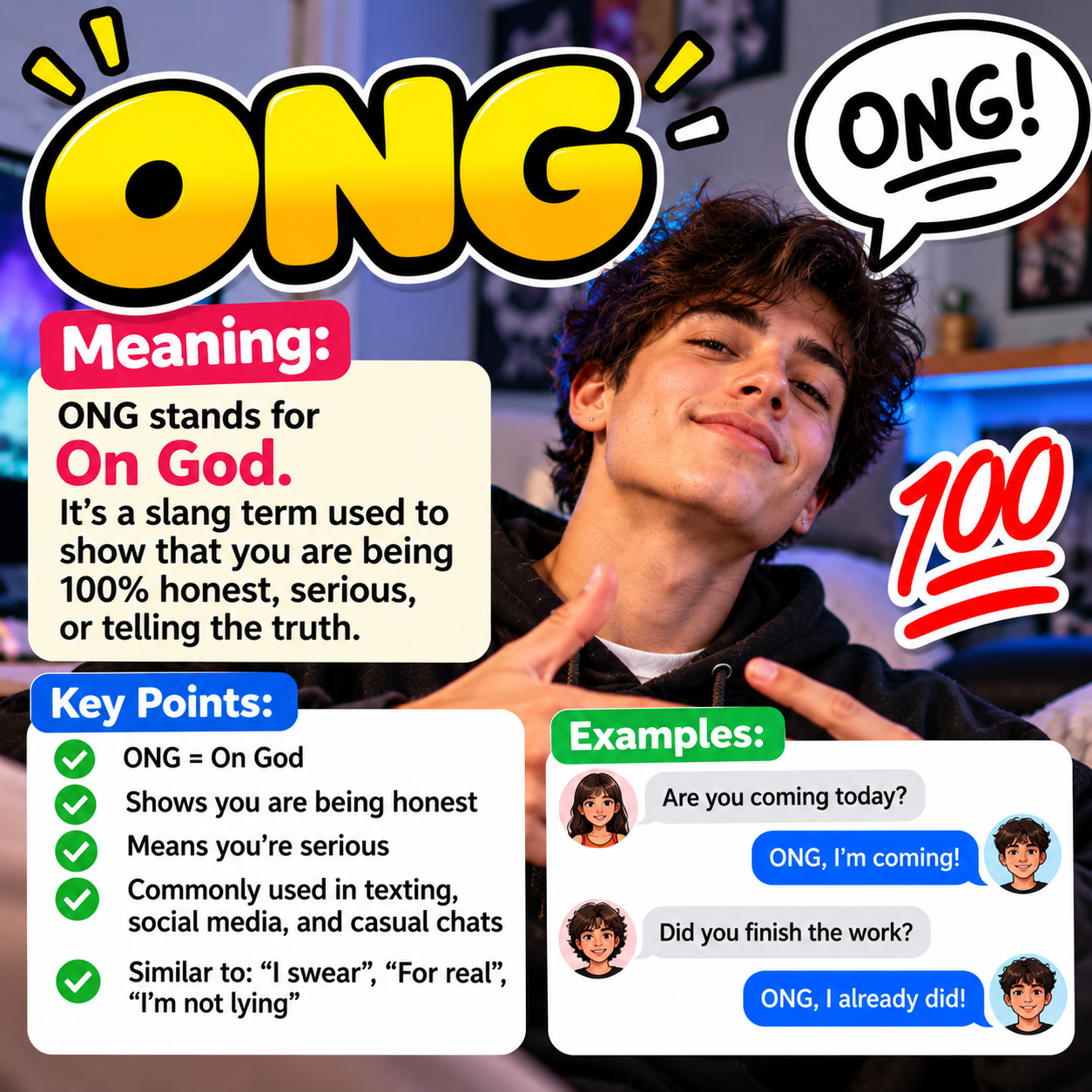
On social media or in a text message, ONG is a popular internet slang acronym that stands for “On God.” It is used to emphasize absolute truth, honesty, or deep personal conviction about a statement, essentially meaning “I swear on God” or “I am telling the total truth.”
If you’ve seen it on TikTok, iMessage, or Twitter and felt out of the loop, you aren’t alone. Digital linguistics move fast. Without understanding the cultural context behind modern slang, it’s easy to misinterpret tone in digital communication—or miss out on genuine cultural resonance when building modern brands.
What Does ONG Mean in Texting & Social Media?
At its core, ONG is an assertion of authenticity. When someone adds “ong” to the end of a sentence, they are putting their reputation on the line to prove they aren’t exaggerating.
Key Contexts for Using ONG:
- Expressing Unfiltered Truth: Clarifying that a surprising fact or story is 100% genuine.
- Showing Intense Agreement: Validating someone else’s opinion with absolute conviction.
- Adding Emotional Emphasis: Highlighting strong frustration, excitement, or agreement.
| Aspect | Details |
| Full Phrase | “On God” |
| Primary Meaning | “I swear”, “No cap”, “Honestly”, “I promise” |
| Tone | Casual, emphatic, informal |
| Common Platforms | TikTok, X (Twitter), iMessage, Discord, Instagram |
Where Did “ONG” Come From? (Origins & Evolution)
While “ONG” exploded across mainstream digital culture through TikTok and Gen Z texting habits around 2020, its roots run much deeper.
The phrase “on God” originated in African American Vernacular English (AAVE) as a spoken oath long before the internet era. As mobile texting and social media expanded, the phrase was shortened to the three-letter acronym ONG for faster typing in chats and video captions.
Today, it sits alongside terms like “no cap” (no lie) and “fr” (for real) as a cornerstone of modern casual dialect.
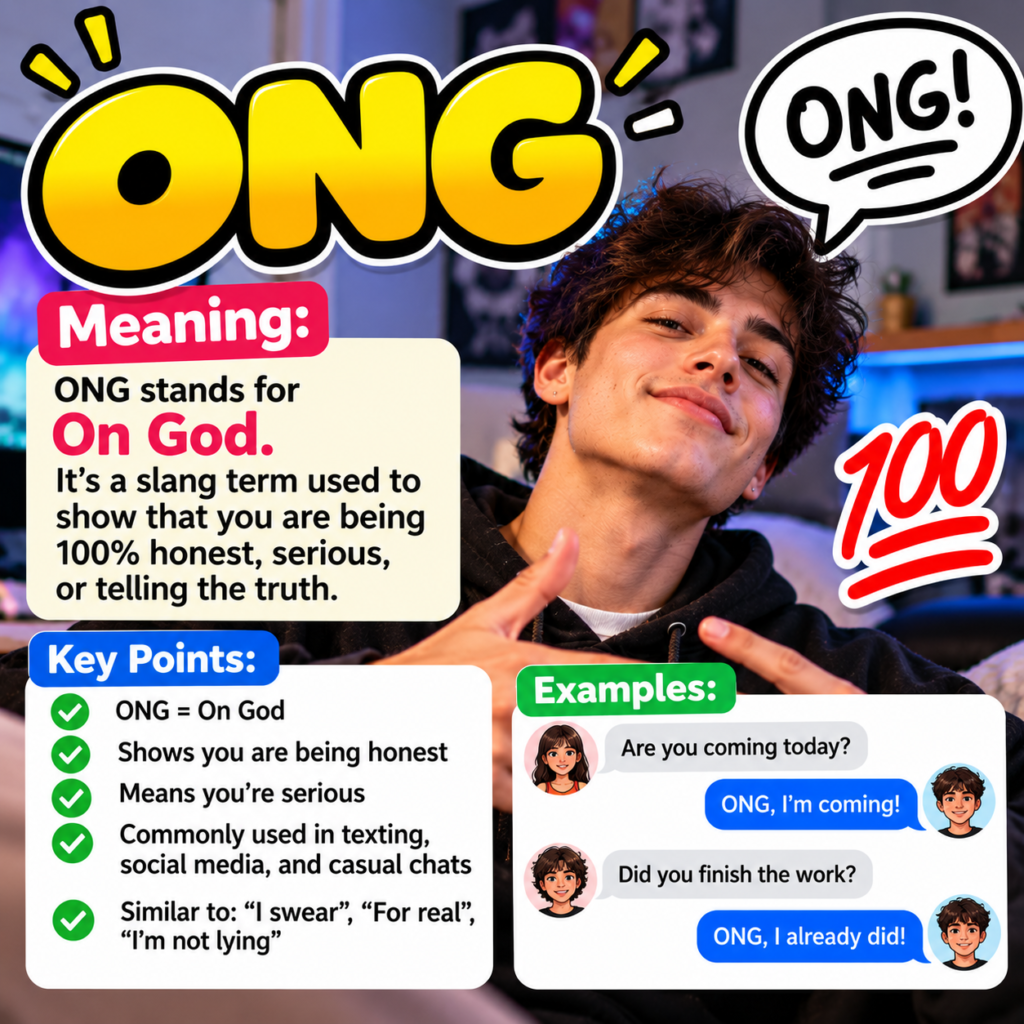
Real-World Examples of ONG in Action
To understand how it flows in conversation, here are common texting scenarios:
1. Agreeing with an Opinion
Person A: That new album is contender for album of the year.
Person B: ONG best release this decade.
2. Confirming a Fact
Person A: Did you actually finish the entire project in one night?
Person B: Yes ong I didn’t sleep at all.
3. Emphasizing Frustration or Passion
Person A: Traffic on the freeway was backed up for two hours.
Person B: That highway is the worst in the state ong.
Linguistic & Naming Psychology: Why “ONG” Sticks
Why do three-letter acronyms like ONG capture so much cultural real estate? It comes down to phonetic efficiency and emotional resonance.
1. High-Impact Efficiency
Short acronyms eliminate friction. In digital communication, brevity equals speed. “ONG” delivers maximum emotional weight with just three keystrokes.
2. Cultural Authenticity & “Vibe”
In brand naming and modern marketing, terms associated with slang carry an immediate sense of raw, unfiltered realism. Consumers—especially younger audiences—are naturally resistant to overly polished corporate speak. They gravitate toward transparent, direct language.
3. The Power of Plosive Sounds
When spoken or read mentally, hard consonants and clear vowel sounds stick in human memory. The hard “G” termination in ONG gives the term a decisive, concrete feel—ideal for establishing trust and finality.
Slang Comparison Matrix: ONG vs. Similar Acronyms
To keep your digital vocabulary accurate, here is how ONG compares to related internet slang:
| Acronym / Term | Full Phrase | Primary Vibe / Meaning | Best Used For |
| ONG | On God | Absolute truth, high conviction | Swearing to honesty or total agreement |
| FR | For Real | Genuine reaction, serious inquiry | Confirming seriousness or asking “really?” |
| No Cap | No Lie / No Fake | Zero exaggeration | Stating an unbelievable but true fact |
| TBH | To Be Honest | Softened opinion, frank admission | Sharing a personal take gently |
| NGL | Not Gonna Lie | Transparent confession | Admitting something candidly |
Common Pitfalls When Using Digital Slang in Branding
Using internet culture to connect with audiences can be a powerful strategy, but it requires extreme precision. Here is where brands often trip up:
- Forced Authenticity (Cringe Factor): Inserting slang like “ONG” into formal corporate communication feels unnatural and erodes audience trust instantly.
- Context Misalignment: Using casual slang in sensitive or high-stakes customer support moments can come across as dismissive or unprofessional.
- Rapid Expiration: Internet slang evolves quickly. Over-indexing on a temporary trend can make brand messaging feel dated within months.
- Trademark & Domain Bottlenecks: Acronyms like ONG are frequently registered across various trademark classes or held by domain squatters, making exact-match brand acquisition difficult.
Strategic Selection Framework: How to Leverage Cultural Terms
When evaluating culturally charged terms or acronyms for brand naming, marketing campaigns, or content strategies, run them through this 4-step filter:
- Test Phonetic Clarity: Say the term aloud 10 times. Is there pronunciation friction? Does it sound smooth in conversational dialogue?
- Audit Audience Alignment: Does your core demographic naturally use this terminology, or will it feel out of touch?
- Check Contextual Longevity: Is the phrase rooted in enduring cultural linguistic patterns, or is it a fleeting two-week trend?
- Verify Entity & Legal Space: Perform a thorough search across business registries, domain availability (.com), and active trademark databases to ensure zero infringement risks.
Frequently Asked Questions
Is “ONG” disrespectful to use?
It depends entirely on the context and audience. While derived from a solemn oath (“on God”), in modern texting and social media, it is almost exclusively used casually to mean “honestly” or “I swear.” However, in formal settings or around religious audiences, opting for “honestly” or “for real” is safer.
What is the difference between ONG and FR?
While both emphasize truth, FR (“For Real”) can be used as a question (“For real?”) or a statement of agreement. ONG (“On God”) is strictly an emphatic declaration of honesty or conviction—you rarely use “ONG?” as a question.
Can ONG mean anything else?
Yes, depending on the context. In corporate or technical environments, ONG can stand for non-slang terms like Optical Network Group or Organically Grown. Always look at the surrounding text to determine intent.
