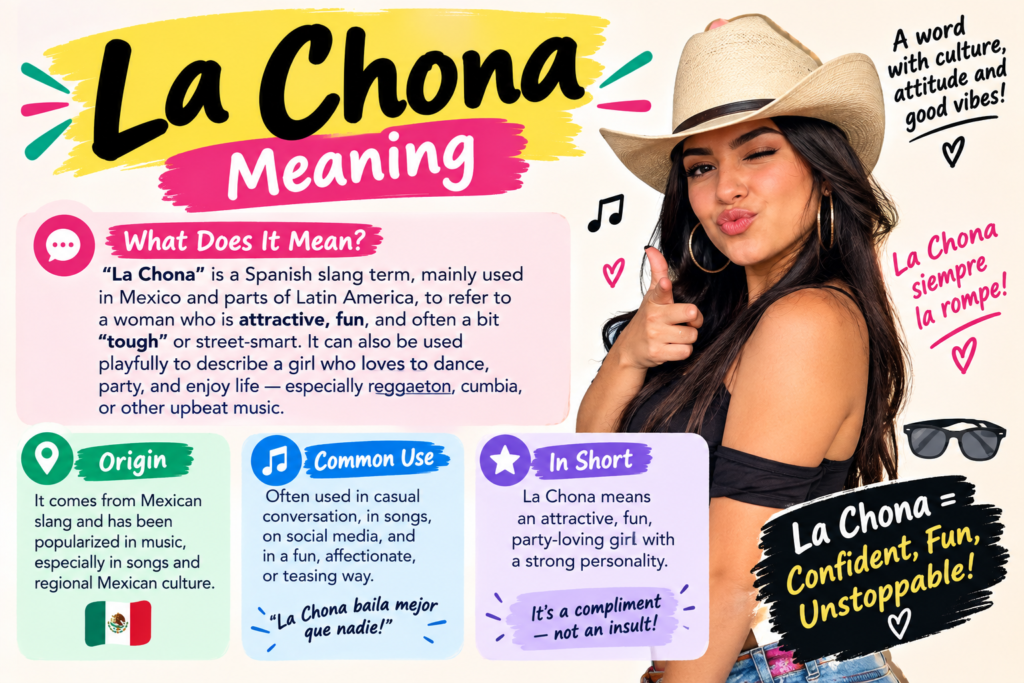

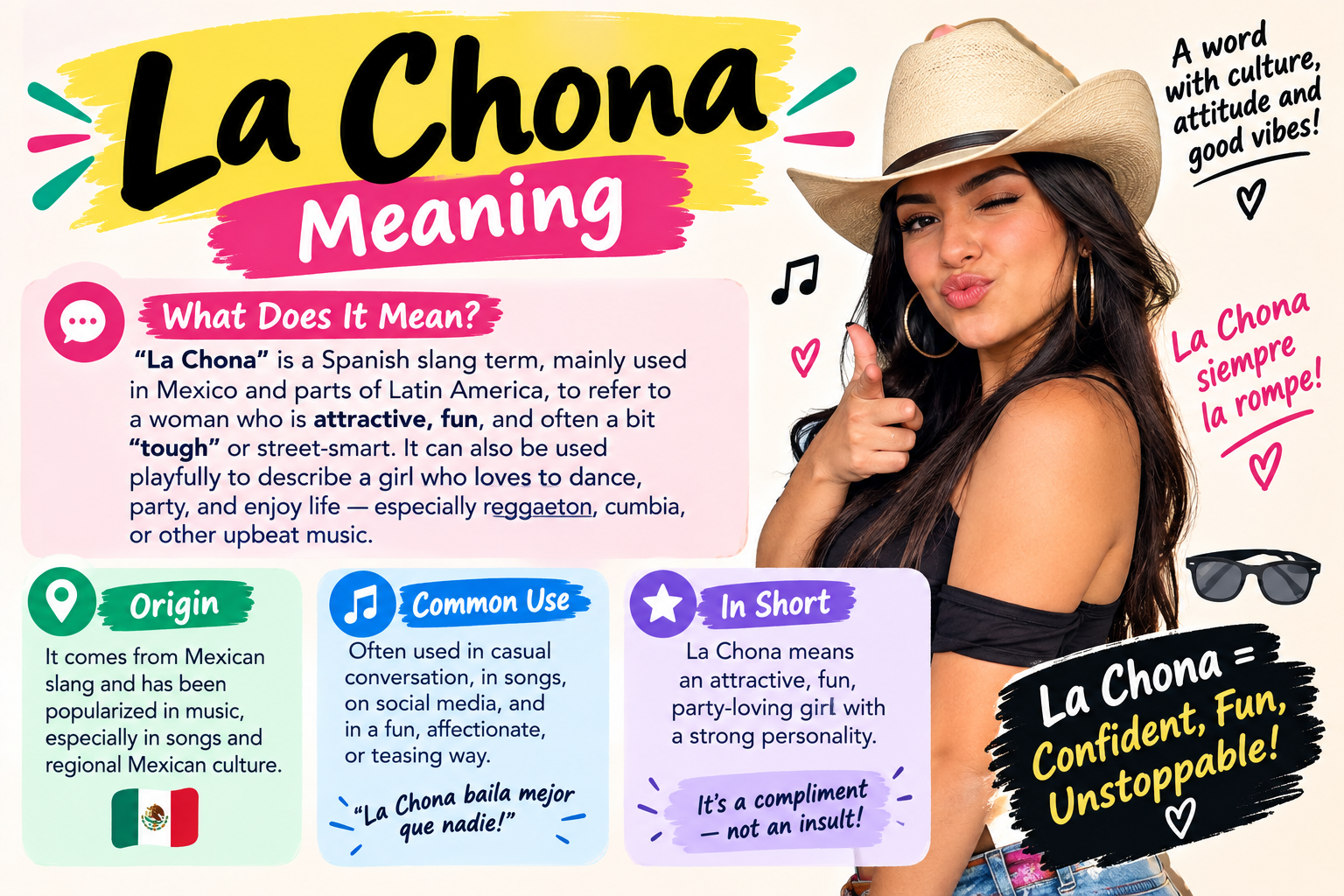
La Chona meaning refers to a high-energy Mexican slang term derived from the nickname “Chona” (short for Conception or Concha), describing an iconic, self-assured woman who loves to party, dance, and live on her own terms. Made world-famous by Los Tucanes de Tijuana in 1995, the phrase has evolved into a global symbol of uninhibited celebration, joyous swagger, and vibrant Northern Mexican pop culture.
Most people who hear the irresistible accordion intro on TikTok or at a wedding know it instantly gets the crowd moving. But if you only view it as a viral dance challenge, you miss the rich linguistic history, branding power, and social identity packed into those two simple words.
Let’s break it down simply. No jargon, just facts.
Linguistic Origins & Naming Psychology
To truly understand what makes the name and phrase land with such weight, we need to trace its root structure and phonetic energy.
The Etymology of “Chona”
In regional Mexican Spanish, nicknames follow specific phonetic shifts. “Concepción” (Conception) or “Concha” naturally softens into “Chona.” Adding the feminine definite article “La” transforms a standard name into an entity—a legend, a character, a larger-than-life personality.
- Phonetic Punch: The double-ch sound (La Chona) delivers high physical resonance. In naming psychology, hard consonants like “Ch” create high recall and energy.
- Cultural Context: In traditional rural communities (particularly in Norteño culture), calling someone by a nickname preceded by “La” signifies notoriety, intimacy, and local celebrity status.
Emotional Triggers and Symbolism
Beyond literal translation, the name triggers distinct psychological associations:
- Unfiltered Confidence: A Chona isn’t concerned with social expectations or modest restraint.
- Rhythmic Joy: The word itself is tied to movement, tempo, and communal celebration.
- Relatability: It represents everyday folk heroism—an ordinary person who commands the entire room simply by being authentic.
The Categorized Archetypes of “La Chona”
When analyzing names or cultural labels for positioning, grouping them by vibe reveals how they function in modern culture. Here is how the concept breaks down across different brand and personality archetypes:
1. The Party Catalyst (Fiesta Energy)
- The Vibe: High tempo, energetic, crowd-pleasing, unapologetic.
- Core Characteristics: Takes center stage, initiates the fun, commands the room.
- Best For: Event production, festival branding, upbeat entertainment media.
2. The Cultural Icon (Authentic Heritage)
- The Vibe: Nostalgic, deeply rooted, regional pride, timelessly recognizable.
- Core Characteristics: Transcends generations, evokes Northern Mexican roots, instantly familiar.
- Best For: Regional food & beverage brands, lifestyle platforms, music media.
3. The Virality Magnet (Modern Social Engine)
- The Vibe: Meme-ready, kinetic, trendy, cross-cultural.
- Core Characteristics: Drives user-generated content, inspires movement/challenges, highly shareable.
- Best For: Social media campaigns, youth movement brands, viral marketing.
Meaning & Vibe Matrix
| Archetype / Dimension | Core Meaning & Vibe | Ideal Brand or Creative Fit |
| Literal Origin | Nickname for Concepción / Concha | Character development, storytelling, biographical media |
| Cultural Slang | A woman who buys booze daily and dances endlessly | Comedy, narrative songwriting, satire, party gear |
| Musical Identity | 1995 Norteño hit by Los Tucanes de Tijuana | Music playlists, festival themes, dance fitness |
| Modern Meme | Unstoppable energy, jumping out of cars, festive hype | Social media campaigns, trend jack marketing |
The Real Story Behind the Song
Here’s where most people get the details wrong: La Chona was not a fictional character created in a boardroom studio.
Written by Mario Quintero Lara, lead vocalist of Los Tucanes de Tijuana, the song was based on a real-life woman in Ensenada, Baja California. Her husband, a local radio announcer named Joaquín “El Chiquilín” Rivera, routinely complained (with affection) that his wife loved partying so much that she bought a bottle of liquor every single day and headed straight to the club.
Quintero Lara wrote the track in 5 minutes after Rivera requested a song about her. The lyric structure captures her ritual:
“Y la Chona se mueve, y la gente le grita… A la Chona se le mueve la colita.”
(And La Chona moves, and the crowd cheers her on… La Chona wiggles her tail.)
The directness of the lyrics, combined with a fast 2/4 rhythm, created an acoustic blueprint for universal crowd engagement.
Common Mistakes When Adapting Cultural Names
Whether you are launching a product, naming a creative project, or leveraging regional trends, avoid these common traps:
- Ignoring Regional Nuance: Slang translates differently across Spanish-speaking regions. What means “party-lover” in Mexico might sound confusing in Spain or Argentina without context.
- Over-Sanitizing the Energy: Trying to make an edgy, vibrant name sound ultra-corporate destroys the exact charm that made it popular.
- Pronunciation Friction: For global audiences, foreign terms with soft or ambiguous sounds can stutter. Fortunately, the “Ch” sound is universal, but matching rhythm matters.
- Trademark and Cultural Bottlenecks: Using iconic song titles directly for commercial trademarks can trigger intellectual property conflicts. Always distinguish between cultural inspiration and protected property.
Strategic Validation Framework
If you are evaluating names or cultural terms for your brand or project, use this 4-step checklist to ensure your naming strategy lands with authority:
- Test Visual Resonance: Does the phrase evoke immediate visual imagery? (e.g., motion, color, celebration).
- Measure Phonetic Friction: Say the term 5 times fast. Does it flow naturally, or does the tongue stumble?
- Audit Cross-Border Appeal: Does the phrase translate as a positive or catchy concept across target markets?
- Check Domain and Entity Space: Look beyond direct .com availability. Search Google, TikTok, and Spotify to evaluate existing entity density.
Frequently Asked Questions
What does “La Chona” mean in English?
Literally, “La Chona” translates to “The [female] Conception.” In slang context, it describes a woman who loves to dance, party, and live freely without caring about what others think.
Is “La Chona” a real person?
Yes. Mario Quintero Lara wrote the song about a real woman from Ensenada, Baja California, whose husband worked in local radio and frequently joked about her love for dancing and night life.
Why did “La Chona” become a viral meme?
The song exploded into global internet culture through dance challenges (such as jumping out of moving cars to dance alongside them in 2018) because of its immediate, high-bpm rhythm and universally relatable party energy.
The 1-Rule Golden Takeaway
A great name or phrase doesn’t force people to remember it; it gives them an emotion they never want to forget.