

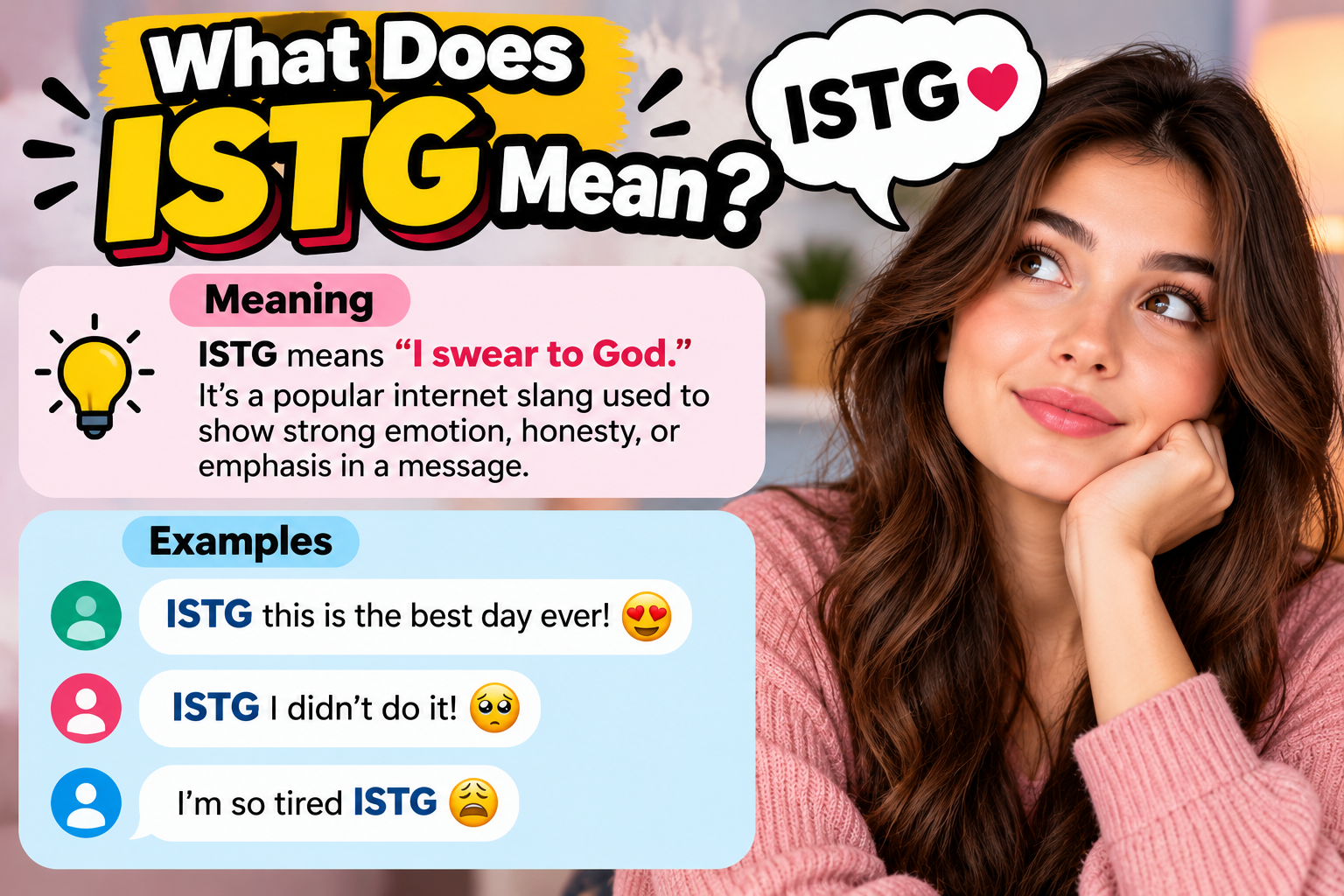
If you have seen ISTG pop up in a text message, TikTok caption, or Instagram comment, it stands for “I Swear To God.” People use this popular acronym to emphasize extreme honesty, express intense frustration, or reinforce a serious promise during online conversations.
While straightforward on the surface, modern internet culture has given this short abbreviation several distinct emotional layers. If you want to understand what does istg means across different social platforms and digital conversations, here is the complete breakdown of its origins, subtle nuances, and modern text etiquette.
What Does ISTG Stand For and How Is It Used?
At its core, ISTG is an acronym for I Swear To God. It acts as a digital exclamation point designed to convince the receiver that you are telling the absolute truth or expressing genuine emotion.
Depending on the conversation, ISTG serves three primary functions:
- To Emphasize Genuine Truth: Used when stating a fact that sounds unbelievable or exaggerated.
- To Express Annoyance or Frustration: Used when someone or something is testing your patience.
- To Highlight Passion or Enthusiasm: Used when praising something you passionately love or recommend.
Understanding the context behind ISTG helps prevent misunderstandings, especially when switching between casual group chats and formal digital communications.
Linguistic & Emotional Breakdown: Why ISTG Works (H2)
The word ISTG carries a unique weight in internet linguistics. Unlike lighthearted slang such as LOL or ROFL, ISTG taps into intense emotional conviction.
1. Phonetic Convenience & Speed
In fast-paced digital messaging, typing four words (I swear to god) interrupts the natural flow of a real-time conversation. Compressing the phrase into ISTG retains the raw emotional intensity while cutting typing effort down to a split second.
2. Sincerity Signal
Online interactions lack vocal tone, facial expressions, and body language. Adding ISTG to a sentence functions as a verbal anchor, signaling to the reader: “I am not joking; take this seriously.”
3. Hyperbole & Drama
Modern text communication relies heavily on hyperbole. ISTG allows users to amplify dramatic effect, making everyday stories sound more engaging and urgent.
Real-World Examples: ISTG in Text Messages & Social Media
To better understand how ISTG shifts meaning based on context, take a look at these everyday text conversation scenarios:
Example 1: Confirming the Truth
Person A: “Did you actually meet him in person?”
Person B: “Yes! ISTG he was standing right next to me at the coffee shop!”
Example 2: Venting Frustration
Person A: “Are you running late again?”
Person B: “The traffic on 5th street is completely stopped. ISTG I’m never taking this route again.”
Example 3: Expressing Enthusiasm
Person A: “Have you tried that new pizza spot?”
Person B: “Yes! ISTG they have the best crust in the entire city.”
Tone Matrix: Contexts & Variations (H2)
| Phrase / Variation | Emotional Tone / Vibe | Best Used For |
| ISTG (All Caps) | High Urgency / Frustration | Serious complaints, intense excitement, or urgent emphasis |
| istg (Lowercase) | Casual / Conversational | Everyday texts, casual gossip, light exaggeration |
| ISTG… (With Ellipsis) | Disbelief / Disappointment | Expressing exasperation or waiting for someone to stop joking |
| I swear to God (Full Phrase) | Direct / Unfiltered | High-stakes serious conversations where full emphasis is needed |
Common Pitfalls When Using ISTG (H2)
While ISTG is widely accepted in digital slang, misusing it can lead to awkward interactions or miscommunication.
- Using It in Professional Settings: Avoid using ISTG in work emails, Slack channels with clients, or formal documents. It comes across as overly informal and unprofessional.
- Misinterpreting Religious Sensitivity: Some individuals prefer to avoid taking religious phrases in vain. In sensitive or formal environments, consider using milder alternatives like “I promise” or “Honestly.”
- Overusing for Minor Things: If you attach ISTG to every single sentence, it loses its emotional weight and makes your messages sound artificially dramatic.
- Ignoring Capitalization Nuance: Writing ISTG in ALL CAPS can make you seem angry or overly intense. Use lowercase
istgfor relaxed, friendly banter.
Strategic Etiquette Framework: How to Decode & Respond to ISTG (H2)
If someone sends you a message containing ISTG, use this simple 3-step evaluation model to crafts the ideal response:
- Analyze the Sentiment: Is the sender excited, annoyed, or trying to prove a point? Look at accompanying emojis or punctuation.
- Match the Energy: If they are venting frustration (“ISTG this line is so long”), validate their experience. If they are excited (“ISTG this song is amazing”), share their enthusiasm.
- Adjust Formalism: Keep your reply casual. Responding formally to a slang-filled message creates a tone disconnect.
Frequently Asked Questions (H2)
Is ISTG considered a bad word or curse?
No, ISTG is not a profanity or curse word. However, because it references deity terminology (“God”), some individuals or formal settings may view it as mildly insensitive or impolite.
What is the difference between ISTG and ONG?
ISTG stands for “I Swear To God,” while ONG stands for “On God.” Both express absolute truth and sincerity, but ONG originated in modern AAVE (African American Vernacular English) and urban slang, carrying a slightly more modern social media vibe.
Is ISTG used in all caps or lowercase?
Both are acceptable. Lowercase (istg) is preferred for everyday casual texting, while uppercase (ISTG) indicates strong emotion, frustration, or dramatic emphasis.
